Search
News - March 2026 RSS Feed
-
Tuesday, March 31, there will be no Mass or Communion Service at noon as all the priests will gather at St. Vincent de Paul Catholic Church for the Chrism Mass. El 31 de marzo, no habrá misa ni servicio de comunión al mediodía, ya que todos los sacerdotes se reunirán en la iglesia católica San Vicente de Paúl para celebrar la Misa Crismal.Read More
-
We have wonderful news to share! Thanks to your support, St. Albert the Great was able to increase our CSA pledge this year to $226,247, which is 162% of our goal. We had the highest number of pledges (916 to be exact) within the Diocese of Austin. Because we were able to meet seven critical categories for success, we are eligible to receive grants from the Diocese! The Diocese of Austin and St. Albert is truly grateful for your kindness. “Together We Bring Hope” is more than just a phrase—it is something we live every day. Thank you, thank you, thank you!Read More
-
MASS LORD'S SUPPER - MISA VESPERTINA DE - LA CENA DEL SEÑOR 4/2, 7:00 PM Bilingual - Bilingüe GOOD FRIDAY - VIERNES SANTO DE LA PASIÓN DEL SEÑOR 4/3, 12:00 PM Stations of the Cross - English 2:45 PM Divine Mercy Chaplet - English 3:15 PM Coronilla de la Divina Misericordia en español seguida del Vía Crucis en vivo 7:00 PM Passion of the Lord Bilingual - PASIÓN DEL SEÑOR - Bilingüe EASTER VIGIL - VIGILIA PASCUAL 4/4, 8:30 PM Bilingual - bilingüeRead More
-
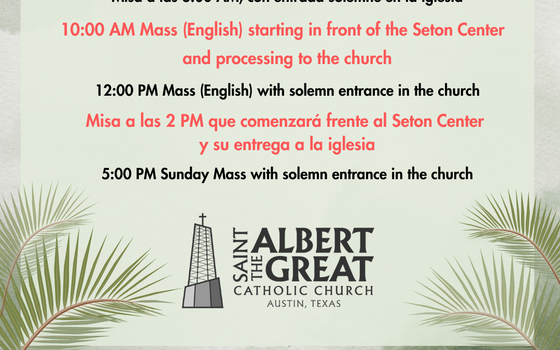
El Domingo de Ramos marca el inicio de la Semana Santa. Este año, haremos una ligera modificación respecto a cómo hemos celebrado el Domingo de Ramos en el pasado. El Misal Romano dice lo siguiente sobre el Domingo de Ramos: «En este día, la Iglesia recuerda la entrada de Cristo Señor en Jerusalén para cumplir su Misterio Pascual».Por consiguiente, el recuerdo de esta entrada del Señor tiene lugar en todas las misas, mediante la procesión o la entrada solemne antes de la misa principal… La entrada solemne, pero no la procesión, puede repetirse antes de otras misas que se celebran habitualmente con una gran concurrencia de fieles. La procesión del Domingo de Ramos se diferencia de la de otros domingos porque la Iglesia prevé que los fieles se reúnan en otro lugar adecuado para comenzar la misa y luego entren en procesión a la iglesia principal. Esta tradición de la procesión nos recuerda la entrada de Jesús en Jerusalén. Los Evangelios nos dicen que las multitudes lo recibieron con ramas de palma y alabanzas. Nuestra procesión es una forma de caminar con Jesús hacia la ciudad santa. Comenzar en un lugar más pequeño representa el camino de la multitud que seguía a Jesús. Entrar en la iglesia principal representa la entrada en Jerusalén y en el Templo. Al caminar, llevar palmas y cantar juntos, participamos en la historia del Evangelio, no solo la escuchamos. En las misas dominicales de las 10:00 a. m. y las 2:00 p. m., nos reuniremos frente al Centro Seton para la bendición de las palmas y la lectura del Evangelio. A continuación, caminaremos juntos hacia el santuario. En estas dos misas, la procesión forma parte integral de la celebración. Si no se siente cómodo o no puede unirse a la procesión desde el Centro Seton, le sugerimos que asista a cualquiera de las otras misas. En todas las demás misas del Domingo de Ramos, celebraremos la Entrada Solemne. La Entrada Solemne nos invita a reunirnos dentro de la iglesia, tal como en una misa dominical habitual. Desde el nártex, el sacerdote bendecirá las palmas y el diácono proclamará el Evangelio antes de continuar con la misa de la manera habitual. ¡Esperamos celebrar el Domingo de Ramos con ustedes!Read More
-
Palm Sunday marks the beginning of Holy Week. This year, we will make a slight modification from how we have observed Palm Sunday in the past. The Roman Missal says the following about Palm Sunday: On this day, the Church recalls the entrance of Christ the Lord into Jerusalem to accomplish his Paschal Mystery. Accordingly, the memorial of this entrance of the Lord takes place at all Masses, by means of the Procession or the Solemn Entrance before the principal Mass… The Solemn Entrance, but not the Procession, may be repeated before other Masses that are usually celebrated with a large gathering of people. The Procession on Palm Sunday is different from other Sundays because the Church envisions the faithful gathering at another suitable place to begin the Mass, then processing into the main church. This procession tradition reminds us of Jesus' entry into Jerusalem. The Gospels tell us that crowds welcomed him with palm branches and praise. Our procession is a way of walking with Jesus into the holy city. Starting in a smaller place shows the journey of the crowd that followed Jesus. Entering the main church stands for entering Jerusalem and the Temple. By walking, carrying palms, and singing together, we take part in the Gospel story, not just listen to it. At the 10 AM and 2 PM Sunday Masses, we will gather in front of the Seton Center for the blessing of palms and the reading of the Gospel. We will then walk together to the Sanctuary. For these two Masses, the procession is integral to the Mass. If you are not comfortable or able to join the procession from the Seton Center, we suggest attending any of the other Masses. At all other Masses on Palm Sunday, we will observe the Solemn Entrance. The Solemn Entrance instructs us to gather inside the church, just like a regular Sunday Mass. From the Narthex, the priest will bless the palms, and the deacon will proclaim the Gospel before we continue Mass in the usual manner We look forward to celebrating Palm Sunday with you!Read More
-
During this season of Lent, we focus on the death/execution of Jesus on the Cross. Our Catholic faith affirms the sacredness of all life and that all of us are to be treated with dignity regardless of actions. And each of us is to be given the opportunity to transform hurt and suffering into healing, redemption, and wholeness. The death penalty violates this divine vision of justice. Even Jesus himself was opposed to the death penalty. In the newly revised (2018) Catechism of the Catholic Church-our teaching now states: “the death penalty is inadmissible because it is an attack on the inviolability and dignity of the person,’ and she works with determination for its abolition worldwide.” (CCC 2267) May our faithful education, catechesis, and formation efforts proclaim the defense of life and human dignity at every age and every stage—and include ending the death penalty. Let us pray for justice and mercy. Please consider joining Catholic Mobilizing Network’s monthly prayer vigils. And each year, CMN hosts the Justice & Mercy Poetry Contest to lift up the voices of young adults-a great way to express your faith during this season of Lent. Submission is through March 20th. Open to ages 18-39. Scan the QR code or visit https://catholicsmobilizing.org/our-work/death-penalty/young-adult-poetry-contest “As long as you did it for one of these the least of my brethren, you did it for me” (Matt. 25:40)”Read More
-
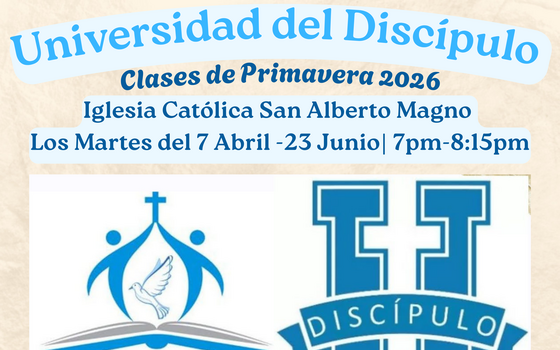
Cursos de Primavera 2026: La Universidad del Discípulo La Universidad del Discípulo y el Ministerio de Crecimiento Espiritual les invitan cordialmente a participar en las clases de primavera de La Universidad del Discípulo. Debido a la transición a una nueva mesa directiva, las clases se llevarán a cabo después de la Pascua, comenzando el 7 de abril y finalizando el 23 de junio. Días: Los martes del 7 de Abril al 23 de Junio Horario: 7:00 p.m. – 8:15 p.m. Registrate en línea con el siguiente código QR Para preguntas o registraciones contáctanos por texto al 512-760-1245 o por correo electrónico a [email protected] ¡Ven y fortalece tu caminar con Cristo y tu formación en la fe!Read More
See More